Tag Archives: literacy

“It may be small, but it’s mighty…”

When I met my newborn book for the first time, it wasn’t love at first sight. I held the tiny tome* in my hand, eyeing it critically, wondering what people would think. Couldn’t she write a book with more pages? Would they think it lacked substance?

A smallish gift book was what I’d planned all along, a volume so not intimidating and so visually appealing that even the most reluctant parent reader would consider picking it up. But when my agent and I met with my editor and the company’s CEO last month via Zoom and learned that Mango had reversed their earlier decision and now planned to print The Invisible Toolbox in soft cover instead of hard, my heart dropped. I was not only disappointed; I was worried. Would a softcover gift book have the same appeal as hardcover?

Mango’s marketing department was concerned that titles comparable to mine were priced at a rate with which a hardcover book wouldn’t be able to compete. Like a wounded parent, I protested: But my book is unique! There isn’t anything out there quite like it. They weren’t moved. And so the decision was made. It was out of my hands.

“I wasn’t sure I could sell it. But then I couldn’t resist.”


When Federal Express left a carton of complimentary author copies on my doorstep this week, I called my agent. “It’s so little.”

She laughed. “Remember, I almost didn’t sign you because the book is so small. I wasn’t sure I could sell it. But then I couldn’t resist.” Julia believes in the message and understands what’s at stake. For her, it’s all about saving democracy. Maybe you’ve seen the meme: A child who reads will be an adult who thinks.

Thank you, Julia, for blowing away any lingering wisps of self-doubt. The Invisible Toolbox may be small. And it may even have a softcover. But its message is mighty.

* An oxymoron, I know, but I like the alliteration.

Thank you, Jeff Conyers, President of Dolly Parton’s Imagination Library and Dollywood!

Dolly Parton’s organization is doing amazing work promoting literacy. Her foundation has donated over a million books to children from birth to age five throughout the U.S., Canada, Australia, and the U.K. I couldn’t be prouder that THE INVISIBLE TOOLBOX has the endorsement of Jeff Conyers, the president of Dolly Parton’s Imagination Library.

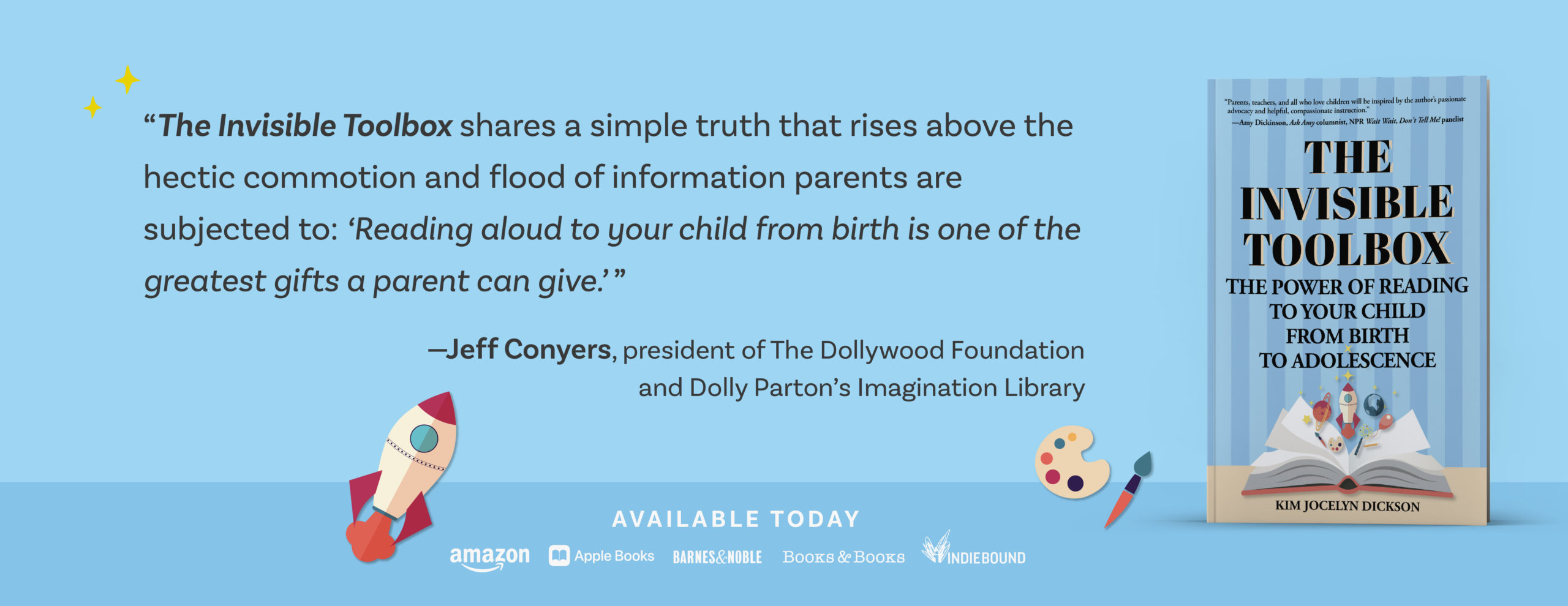
Here’s what Jeff had to say after reading The Invisible Toolbox:

The Invisible Toolbox shares a simple truth that rises above the flood of information parents are subjected to: ‘Reading aloud to your child from birth is one of the greatest gifts a parent can give.’ This book will tell you why and what you can do to develop a lifelong love of books and reading with your child.”

Available now!

THE INVISIBLE TOOLBOX Cover Reveal…

Coming April 14, 2020. Available for pre-order on Amazon now.

The Critical First Five Years

As much as we’d like to believe that children arrive at school on the first day of kindergarten with comparable reservoirs of potential, the sad reality is this simply isn’t true. From the very beginning of their school lives, the playing field is not even. Children arrive in wide-ranging states of readiness to learn, predetermined by their early language experiences.

Watch this powerful graphic illustration of the impact of the first five years on a child’s future learning trajectory from The Children’s Reading Foundation:

The fact is, children who have been read to regularly come equipped with the critical tools they need for the world of school. Children who lack this experience enter school already behind and, as the video reveals, they rarely catch up.

By reading to our children from birth on, we can build a foundation of literacy skills that will not only enable them to enter kindergarten on day one with joy and confidence, but carry them successfully far into the future.

The Power of a Reading Promise

If you think a nightly read aloud ritual between parent and child is a luxury only for those who are well off with smoothly running lives, think again. Alice Ozma’s best-selling memoir, The Reading Promise: My Father and the Books We Shared doesn’t just dispel that notion; it illustrates that this simple, daily communion between a book, a child, and a parent can shine a light that soothes the pain of the present and points the way to a hopeful future.

Alice’s father, an elementary school librarian, was fortunate to have a mother who read to him as a young boy. When his daughter Alice was nine, they made a pact to read aloud together for one hundred nights straight. The pact eventually became known as The Streak, stretching out into 3,200 nights and nearly nine years. They marked the final night of The Streak on the steps of Alice’s college dorm, reading The Wonderful Wizard of Oz, symbolically, because it was the book with which they started.

One suspects that their commitment to The Streak was intensified by the family’s rupture. The Thanksgiving Alice was nine her mother, who we later learn suffered from mental illness, abruptly moved out, leaving Alice’s father to parent two daughters alone. As a man not prone to talking about his feelings, he wasn’t able to help his youngest directly process her own. What he was able to do though, was give her the gift of himself, his time, and his love of books. Through sharing fiction together daily, he not only strengthened his connection with his daughter, he opened worlds of possibility to her.

Recent studies in neuroscience show that we experience fiction as if it’s actually happening to us. Beyond the language-processing parts of the brain that are triggered when we read, the sensory regions are as well. So when we talk about entering into the world of the story, this is in fact what our brains do. Despite the obvious pain that is far below the surface in Alice’s retelling of her story, she is carried along and buoyed by her father’s love and the worlds they share. The loss of her mother, a father who is not comfortable talking about feelings, and her family’s limited financial resources are not determinative for her.

Throughout her school career Alice scored at the top of her class in reading and won awards in writing. Then her graduate school admissions essay on The Streak became a New York Times article which led to publishers taking notice. And so she found herself writing a memoir at the age of twenty-three. Hers is a story that will make you laugh out loud and maybe tear up too, but never is it sentimental or cloying. It is deeply moving, though. If you’re a parent of young children, it may inspire you to make your own reading promise. For this parent of a young adult, I found myself wishing for a do-over—wistful that I didn’t continue read aloud time with my son beyond elementary school.

Originally published by Kim Jocelyn Dickson at fractuslearning.com.