And What We Can Do About It
When smart devices launched fifteen or so years ago, many believed that access to all the information in the world at our fingertips could only enhance human life.
Parents gave their children phones and tablets. Schools embraced educational technology, issuing devices to each student and adopting technology-based curriculum.
If you happened across Goodnight iPad as I did in 2011, you might have picked up on the warnings that emanated from its pages. I explained some of them in part one. You may want to take a look at that before you go on if you haven’t already.
It’s taken the wider public nearly a generation to see what Goodnight iPad warned us about.
Now we know. The generation that grew up never knowing a world without smart devices has disproportionately experienced more mental health and learning issues.
As it turns out, access to all the information in the world is not necessarily what children need.
The good news is that people are waking up and are ready and willing to rethink what kids actually do require in order to thrive.
As I mentioned in part one, my reading of Goodnight iPad in 2011 elicited a thunderbolt of insight.
Having taught elementary school for years, I could already see the impact of smart devices on the students who had them.
If a child had the ability to choose to play a game, scroll Instagram on an iPad—or read a book—what would they choose? It wasn’t difficult to see where the proliferation of smart devices would lead.
Any teacher knows that the amount of time a child chooses to read outside of school has a direct impact on their ability to achieve.
Now, here we are, fifteen years later and the data has shown us. Reading for pleasure among adults as well as children has declined. Literacy rates are down. In fact, achievement across all subjects has declined.
Is there a way back from our technological capture that, post-pandemic, has meant more time on devices for children even during the school day? Or are we doomed to a future of distraction and decline?
I believe there is a way back. It’s very simple, and it begins with parents.
- Read to your child daily. Begin at birth. If your child is older, it’s not too late. Start now. Let them see you reading. You are their best model. Never really enjoyed it? You just haven’t found the right books yet. Help them find theirs too.
- Delay giving your child a personal device. Delay, delay, delay. Be on the lookout for families who are like-minded which will diminish the peer pressure factor.
- If possible, choose a school that uses pencil and paper and does not place EdTech on 1:1 devices at the center of learning for students. For young children, it’s a good sign if they have ‘technology’ as a stand-alone subject, not as the primary tool of learning.
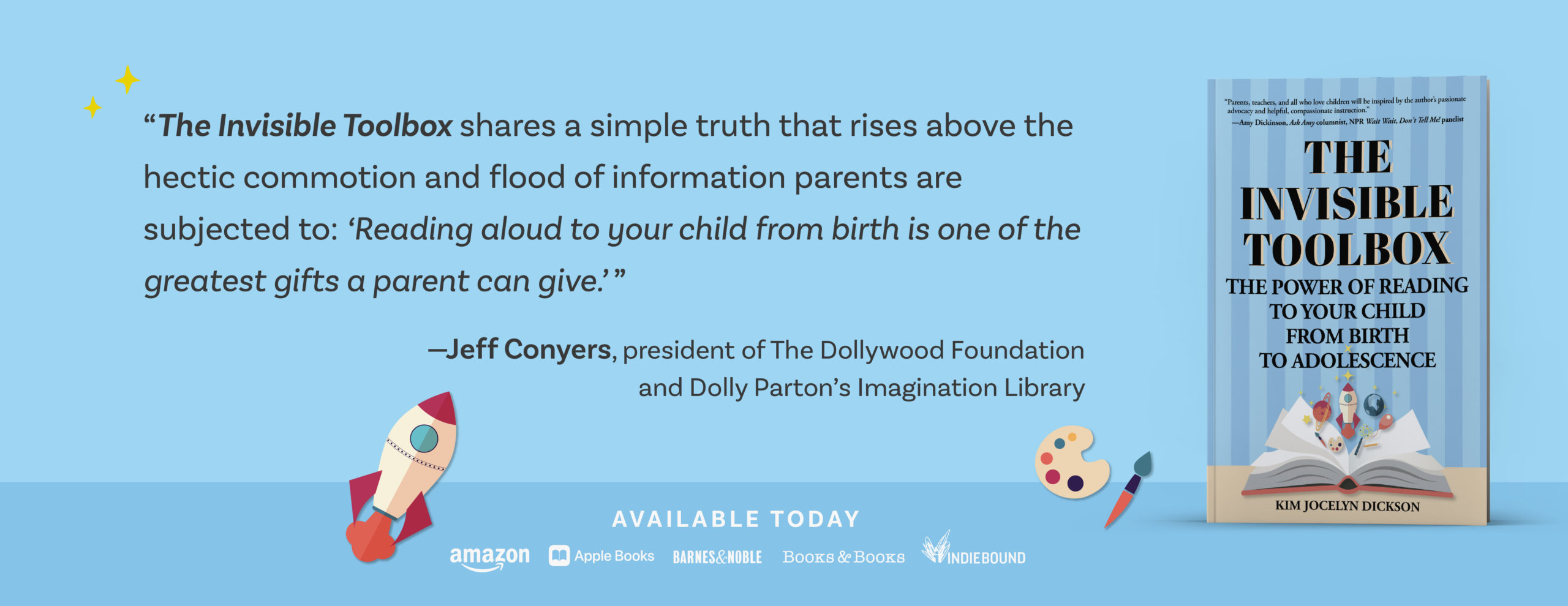
For me, the bolt of insight Goodnight iPad struck gestated into writing The Invisible Toolbox: The Power of Reading to Your Child from Birth to Adolescence.
I wanted parents to understand why shared reading is one of the greatest gifts they can give their child.
My theory of the invisible toolbox was initially anecdotal, based on my experience and classroom observations. But neuroscience has proven it to be spot on.
Dr. John Hutton, Pediatrician and Director of Cincinnati Children’s Hospital Reading and Literacy Discovery Center, has done exciting research that confirmed what I observed in the classroom.
Through neuroimaging the brains of preschool age children, Hutton and his team discovered that the amount of parent-child reading—and screen time—directly impact brain development.
Hutton observed that the brains of children who have been read to regularly and had less screen time developed more white matter tracts than children who had more screen time.
White matter is an indication that the neurons are firing and making connections all over the brain. Cross-brain neurological activity is a physical reaction to reading and being read to. These children showed a greater capacity for language skills and higher executive functioning than their peers who had more digital exposure.
We can think of the white matter of the brain as the physical manifestation of the metaphor of the invisible toolbox. The pre-literacy tools a child will carry to kindergarten with them are a by-product of these neurological connections.
Tragically, children who are not read to will not develop the neurological language connections they need in order to learn. They actually arrive at kindergarten already behind.
When parents teach their children to love reading for pleasure and immerse them in real life experiences over virtual ones by delaying personal screen use, they create a foundation in which their child can thrive both emotionally and academically.
The logical outcome of the scenario portrayed in Goodnight iPad does not have to be determinative.
Parents have a choice.