Yet Dolly Parton’s Life Changing Legacy Will Live On
She wasn’t able to have children of her own, yet Dolly Parton gave children all over the world one of the greatest gifts a parent can give. The love of reading.
So far over 300 million books are in the hands of children because of the dream she had, inspired by her father. “The smartest man I ever knew” who never learned to read.
Because of Dolly Parton’s mission to share love and light, “her kids” come to kindergarten ready and eager to learn to read.
I have a feeling the Imagination Library’s wild success is only going to expand mightily going forward.
After all, Dolly is up there singing with the angels now, and she has undoubtedly got the ear of the One who loves children as she does.
My deepest condolences go out to the wonderful people at the Imagination Library who have helped to make her dream come true.
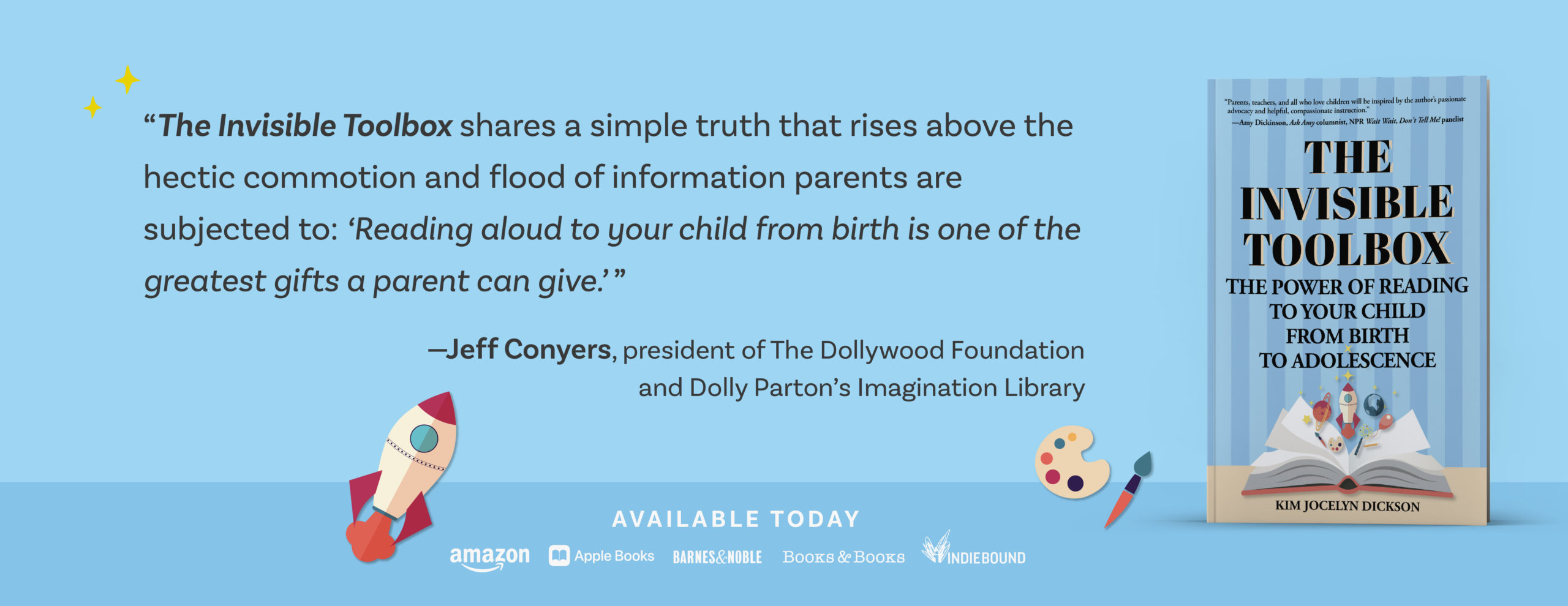
On a personal note, I will be forever grateful to the president of The Imagination Library and Dollywood Foundation, Jeff Conyers, for his support for The Invisible Toolbox. When my agent reached out and invited him to read it in manuscript form for comment, he kindly said yes and then wrote a beautiful blurb that we used on the back cover.
I was beyond thrilled.
Then in 2021 I was invited to speak at the Imagination Library’s biannual Homecoming. That year it was virtual instead of its usual gathering in Pigeon Forge, Tennessee, the home of Dollywood. But the upside of that was that volunteers from all over the world, from the UK, Canada, Australia, and the Republic of Ireland, were able to join in.
I’ve been an enthusiastic believer in Dolly’s mission for a long time. Her focus on getting books into the hands of children and their parents from the beginning of their little lives until they start kindergarten is brilliant.
Dolly was an incredibly smart lady who understood that the love of reading and preparation to learn how begins at the beginning, on the lap of a loving parent.
When it comes to declining literacy rates, it’s increasingly important that we take a close look at what children experience in their earliest years before formal school begins. The Imagination Library is destined to become more relevant than ever in addressing this.
When smart devices launched fifteen or so years ago, many believed that access to all the information in the world at our fingertips could only enhance human life.
Parents gave their children phones and tablets. Schools embraced educational technology, issuing devices to each student and adopting technology-based curriculum.
If you happened across Goodnight iPad as I did in 2011, you might have picked up on the warnings that emanated from its pages. I explained some of them in part one. You may want to take a look at that before you go on if you haven’t already.
It’s taken the wider public nearly a generation to see what Goodnight iPad warned us about.
Now we know. The generation that grew up never knowing a world without smart devices has disproportionately experienced more mental health and learning issues.
As it turns out, access to all the information in the world is not necessarily what children need.
The good news is that people are waking up and are ready and willing to rethink what kids actually do require in order to thrive.
As I mentioned in part one, my reading of Goodnight iPad in 2011 elicited a thunderbolt of insight.
Having taught elementary school for years, I could already see the impact of smart devices on the students who had them.
If a child had the ability to choose to play a game, scroll Instagram on an iPad—or read a book—what would they choose? It wasn’t difficult to see where the proliferation of smart devices would lead.
Any teacher knows that the amount of time a child chooses to read outside of school has a direct impact on their ability to achieve.
Now, here we are, fifteen years later and the data has shown us. Reading for pleasure among adults as well as children has declined. Literacy rates are down. In fact, achievement across all subjects has declined.
Is there a way back from our technological capture that, post-pandemic, has meant more time on devices for children even during the school day? Or are we doomed to a future of distraction and decline?
I believe there is a way back. It’s very simple, and it begins with parents.
Read to your child daily. Begin at birth. If your child is older, it’s not too late. Start now. Let them see you reading. You are their best model. Never really enjoyed it? You just haven’t found the right books yet. Help them find theirs too.
Delay giving your child a personal device. Delay, delay, delay. Be on the lookout for families who are like-minded which will diminish the peer pressure factor.
If possible, choose a school that uses pencil and paper and does not place EdTech on 1:1 devices at the center of learning for students. For young children, it’s a good sign if they have ‘technology’ as a stand-alone subject, not as the primary tool of learning.
For me, the bolt of insight Goodnight iPad struck gestated into writing The Invisible Toolbox: The Power of Reading to Your Child from Birth to Adolescence.
I wanted parents to understand why shared reading is one of the greatest gifts they can give their child.
My theory of the invisible toolbox was initially anecdotal, based on my experience and classroom observations. But neuroscience has proven it to be spot on.
Dr. John Hutton, Pediatrician and Director of Cincinnati Children’s Hospital Reading and Literacy Discovery Center, has done exciting research that confirmed what I observed in the classroom.
Through neuroimaging the brains of preschool age children, Hutton and his team discovered that the amount of parent-child reading—and screen time—directly impact brain development.
Hutton observed that the brains of children who have been read to regularly and had less screen time developed more white matter tracts than children who had more screen time.
White matter is an indication that the neurons are firing and making connections all over the brain. Cross-brain neurological activity is a physical reaction to reading and being read to. These children showed a greater capacity for language skills and higher executive functioning than their peers who had more digital exposure.
We can think of the white matter of the brain as the physical manifestation of the metaphor of the invisible toolbox. The pre-literacy tools a child will carry to kindergarten with them are a by-product of these neurological connections.
Tragically, children who are not read to will not develop the neurological language connections they need in order to learn. They actually arrive at kindergarten already behind.
When parents teach their children to love reading for pleasure and immerse them in real life experiences over virtual ones by delaying personal screen use, they create a foundation in which their child can thrive both emotionally and academically.
The logical outcome of the scenario portrayed in Goodnight iPad does not have to be determinative.
It caught my eye immediately as it slipped into the classroom library basket. “What is THAT?
My fifth grade student brought it over to me. She was a voracious reader, and picture books were not her usual fare.
But, like me, she must have recognized its connection to everyone’s favorite bedtime classic. I’d read Goodnight Moon so many times to my son that I knew it by heart.
It was 2011. Just one year after the iPad’s launch. A few fifth graders had them at home.
The impact of the digital world on my students was already evident
A few more had their own iPhones. One fifth grader, as I recall, already had hundreds of followers on Instagram. Once, she showed me a picture of a bug she’d posted. A bug. It had hundreds of likes.
The impact of the digital world on my students was already evident. Except for their technology class, their access was entirely outside of school at this time.
But it showed up in their conversations, in their interest in books and their homework, and at dismissal to carpool at the end of the day. The first thing the kids who had phones did when they left class was pull them out and scroll or text.
The big question often discussed among parents and teachers back then was Do children really need their own phones? As we would learn, the collective answer was going to be ‘yes.’
Goodnight iPad! I couldn’t wait for my next planning period when I could sit down and read it.
That reading was a pivotal moment for me. Looking back, I think it’s the moment when I knew I would eventually write The Invisible Toolbox.
I’d long been interested in how the simple practice of parents reading to their children regularly in the early years impacted their child’s future learning. Through my many years in the classroom and as a parent, I could see that it mattered a lot.
Goodnight iPad portended a future in which this was much less likely to happen.
Much in this charming story, penned cleverly by author Ann Droyd, is dated. It’s been 15 years after all. Remember Angry Birds? A 2009-launched massively popular video game. Blackberries? Originally a hand-held pager, it evolved into a smartphone.
Regardless, there were harbingers of truth that predicted exactly where we are now. They’re so obvious that it may be unnecessary to point them out. But I will anyway, because they’ve had a profound effect on children’s brain development and ability to learn.
Isolation and Fragmented Attention
Instead of one little bunny and the old lady whispering, “hush,” we have three generations of bunnies. Quite a few bunny children, a set of parents, and a grandmother—all absorbed in their own devices. Except for Granny.
Video games, movies on the big screen, iPhones, Facebook, YouTube videos. Dad appears to be reading a digital book on a Nook, Barnes and Noble’s now discontinued e-reader. Granny, trying to catch a few winks, grows frustrated watching all this from her rocker, unable to sleep because of the noise of the ‘bings, bongs, and beeps’ all around her.
For those of us of a certain age who can remember growing up with limited TV channels and no personal devices, the loss of family-oriented leisure time is obvious. No one is sharing anything. Each family member is absorbed in the world of their own device.
No one is sharing anything. Each family member is absorbed in the world of their own device
The one exception is the group gathered around the enormous TV watching a scene from the 1968 Stanley Kubrick sci-fi film classic 2001: A Space Odyssey. A group of monkeys are gathered around a black monolith which, in the movie, represents a “religious or mystical object of transcendence that triggers the final step in human evolution.”
The final step in human evolution.
Looks like the author was trying to tell us something.
The symbolism is apt. Like the monkeys, our attention has been fully captured by an inanimate, yet transcendent, object. We now have a window with a view into, arguably, everything in the world.
Jonathan Haidt, author of The Anxious Generation (2024), might agree. He’s revised his former belief that anxiety is the most concerning fallout of the digital age. Haidt now believes that loss of attention is even more consequential. Our ability to think deeply and persevere is eroding.
But maybe even more damaging is that in taking us out of our lived world virtually, our ability to connect in the present is diminished.
Distracted Parents
In our story scenario Mom and Dad are every bit as absorbed in in their own devices as the kids are.
When sleepless Granny finally has had enough of the digital cacophony, she puts her foot down and yells, “Okay, that’s it!”
No gentle hushing here. She’s on her feet now, gathering up everyone’s devices.
Oh, the begging, the tears, and tugs of war. Mom, still dressed in her corporate suit—it was 2011 after all—is just as distressed as the kids are at having her Blackberry taken away.
Out it all goes—right out the window!
It’s a very funny scene, but sadly true at the same time. Parents are now just as addicted to their screens as their kids are.
We’ve all seen the family out for a meal together at a restaurant with everyone on their phones instead of engaging with one another. Or the toddler in the grocery store cart, Mom’s phone in hand, making it easier for her to get the errand over with.
Parents are now just as addicted to their screens as their kids are
Screens have become so vital to our everyday experience and so tempting for use as a babysitter that many parents haven’t paused to consider the effects on their children.
Common Sense Media recently reported that 40% of toddlers now have their own tablets by the time they’re two. More than 50% have their own device by age 4.
That statistic makes me shudder.
Studies of children’s brain scans show that children who have significant screen time have less white matter than those who not only don’t, but have also been read to. This means fewer neural connections are made, the very infrastructure necessary for language and literacy.
Even scans of children with less than two hours of daily screen time show reduced white matter.
The distraction of parents that includes lack of awareness about screen damage means that children may not be getting the attention they need from their parents—or the shared activity that would be the greatest gift they could receive from them.
Decline in Reading for Pleasure
This picture is the saddest and most telling one of all.
Gen X Bunny Dad may still read a novel, but he’s on his e-book, so the children don’t see actual book reading modeled by an adult.
The cobwebbed bookshelves are bare. Whatever books that remained are trashed along with the newspaper and the gooseneck reading lamp.
This doesn’t bode well for the bunny kids’ futures, and it’s unfortunately what many households look like today.
Children with no books in the home will be behind when they start kindergarten. When children struggle to learn to read, they’re much less likely to pick up a habit of reading for pleasure.
Children with no books in the home will be behind when they start kindergarten
The Children’s Reading Foundation reports that 4 out of 10 children entering kindergarten in the U.S. are three years behind their peers, and 75% of them will never catch up.
Jim Trelease, author of The Read Aloud Handbook, explained that vocabulary is the #1 predictor of school success. Numerous studies show that reading aloud to children even once daily in the earliest years exposes them to 296,660 more words than their peers who were never read to. Reading five books a day will result in a 1.4 million word advantage.
Children who are read to in the early years arrive at kindergarten with a lunchbox in one hand and an invisible toolbox in the other that holds the pre-literacy tools they need to learn to read. They’re also more likely to develop a reading for pleasure habit.
For a growing number of parents, however, the practice of daily shared reading is waning. A Harper Collins UK survey last year reported that more than half of the Gen Z parents asked did not “enjoy” reading to their children.
The decline in reading for pleasure means less cognitive development and lower test scores across all subjects.
In school age students, our nation’s report card the NAEP, indicates that reading scores continue to fall. In 2024, 69% of our 4th graders did not test as proficient readers. 70% of 8th graders were not proficient.
The ACT scores of college-bound high school seniors have dropped in all subjects. Children who don’t read well will struggle to learn in all areas.
College professors complain they’ve had to reduce the amount of expected reading for their classes drastically.
The loss of the habit of reading for pleasure has far-reaching results that profoundly affects learning potential.
Are we doomed to a future loss of attention and decline?
Is there a way back from our technological capture that, post-pandemic, means more time on devices even during the school day? Are we doomed to a future loss of attention and decline?
The author hints at the antidote in the final page.
In my next post I’ll address what parents can do to help insulate their child from the spell of these “mystical objects of transcendence.” Stay tuned.
And It Appears That Schools May Be Contributing to their Decline
Last week’s Senate hearing on the impact of technology, social media, and artificial intelligence on the mental health of children and teenagers is well worth a watch.
This is especially true if you’re new to understanding how smart devices have influenced education in the last fifteen years.
But if you can’t fit in the entire two hour discussion, be sure to spend just a few minutes watching former teacher, cognitive scientist, and author Dr. Jared Cooney Horvath’s introductory remarks.
Video source: Scrolling 2 Death
Horvath studies how learning happens physiologically. According to him, humans are biologically programmed to learn from other humans, and screens circumvent the process.
Horvath along with co-panelist Emily Cherkin advocate for eliminating technology as the primary tool for learning in schools.
During the pandemic, schools were shut down, Chromebooks were issued to each student, and became, of necessity, the primary means of instruction. When schools opened up again, students returned along with this new—or at least more intensively used—way of teaching and learning.
The result is that on top of the hours spent on screens during their free time (estimates vary widely from 1 to 7 hours) , an additional 4 to 6 hours of instructional time were added during the school day.
You would think our collective hair would be on fire with data like this, wouldn’t you?
The plummeting ACT scores in the graph above underscore Horvath’s conviction that the tech tools schools use are, if not causing, then correlated to a decline in our students’ cognitive ability.
You would think our collective hair would be on fire with data like this, wouldn’t you?
So why isn’t it?
Photo source: First Fish Chronicles on Substack
Horvath’s co-panelist Emily Cherkin has some answers.
In her recent Substack post “Don’t Ask the Barber if You Need a Haircut” (which you can read without a subscription if you’re on her email list at First Fish Chronicles), she explains that the EdTech industry is “expected to be worth up to $570 Billion by 2034.”
Yes, you read that correctly. 570 BILLION.
Coincidentally, Cherkin reports, an organization entitled the Consortium for School Networking (CoSN) sent a letter ahead of the hearing to Senator Ted Cruz, the Chair of the Senate committee. The letter explained that there’s a big difference between screentime use OUTSIDE of school and the objective-driven instructional use of screens INSIDE school.
In other words, criticism and regulation of social media and technology use for kids in general is fine. But decisions about school screen use? This must be left to the experts.
Here’s the problem. The experts seem to be oblivious about what the data shows about EdTech and learning.
Take a look at the list of organizations Cherkin cites in her article that signed the CoSN letter prior to the hearing:
AASA, The School Superintendents Association
AESA, Association of Education Service Agencies
American Federation of School Administrators
American Federation of Teachers (AFT)
American Library Association (ALA)
Association of School Business Officials International (ASBO)
Benton Foundation
CoSN – The Consortium for School Networking
Consortium of State School Boards Association (COSSBA)
National Association of Elementary School Principals (NAESP)
National Association of Federally Impacted Schools (NAFIS)
National Association of Independent Schools (NAIS)
National Association of Secondary School Principals (NASSP)
Schools, Health & Libraries Broadband Coalition (SHLB)
…the experts seem to be oblivious about what the data shows about EdTech and learning
These groups represent the people one expects to be most committed to children’s well-being and learning, the people that parents who aren’t educators themselves look to and trust.
Have the educational decision makers all simply been bought off by this big money industry? Or are the experts actually unaware when it comes to what children really need in order to learn?
In my opinion, both reasons are probably factors. I speak from over 30 years teaching in both public and independent schools.
Many teachers and administrators don’t really understand the biology of learning and the neurological complexity of what is goes on in the learning process.
In my book about the importance of reading aloud to children from the beginning, I describe this neurological phenomenon as the invisible toolbox— a metaphor for the connections that are made in the brain in the interplay of human connection and learning.
When EdTech companies market their wares promising personalized learning, guaranteed results, and the necessity of tech experience in the formative years for a future work force, many educators and administrators believe them.
But as Cherkin has shown, there’s also a lot of money at stake to keep the industry alive and booming.
Read my review of Screen Schooled: Two Veteran Teachers Expose How Technology Overuse is Making Our Kids Dumber (Clement and Miles, 2019) to learn about what the authors call The Education-Industrial Complex. They describe a network of oligarchs and politicians who have neither background nor expertise in education or child development, yet have an outsized influence on curriculum in the U.S.
As schools move to ban phones during the school day, the great irony is that screen use continues widely within schools. iPads and Chromebooks are essentially just oversized phones.
And, as Dr. Horvath explains, screens simply are not what the human brain needs for deep learning.
Despite LOTS of federal money pouring out the door to schools after the pandemic and the resurgence of phonics instruction via the Science of Reading in the eternal reading wars, the 2024 Nation’s Report Card*, unveiled this week, continued to report unhappy results.
This did not surprise me.
What would have surprised me about this year’s results would have been if we had seen growth in each group. Here’s why.
As students returned to school post-pandemic, their one to one laptops returned with them. So did the heavily tech-based work that they’d done in distance learning.
What did this mean for students? It meant less time reading actual books.
Reading is now often limited to short passages on screens or even via audio books in class.
As a teacher for over 3 decades, it was always obvious to me that students who scored as proficient readers read not only what was assigned for class, but also books of their own choice.
As with any skill, proficiency comes with practice. Reading is no different.
Changing Expectations for Independent Reading
Last November The Atlantic published an article entitled “The Elite College Students Who Can’t Read Books” with the subheading: ‘To read a book in college, it helps to have read a book in high school.’
Expectations for students as readers have changed.
When a friend stepped in as a substitute teacher for a 10th and 11th grade high school English teacher who left for medical leave, he was given these instructions:
Don’t expect the kids to do any assigned reading outside of class.
You’ll read The Great Gatsby in class together via audiobook.
Then the kids will do their follow up questions independently on their Chromebooks.
This scenario occurred in a typical suburban school that included both working and middle class kids.
If students won’t do the assigned reading to prepare for class, is it likely they’re doing their own reading for pleasure at home? I think not.
Hence, there’s very little time spent actually reading.
Little practice equals low proficiency.
The cocktail of our kids’ over-saturation in technology both at home and at school combined with low expectations is a recipe for continued stagnation and decline in reading scores.
The 4th graders of 2024 were in kindergarten when schools were shut down, so their introduction to school was screen-based. The students who didn’t have parents at home who read to them were—and are—at a huge risk for reading failure.
When 69% of our nation’s 4th graders and 70% of our 8th graders are only able to read at a basic or below basic level, it has got to be a wake-up call.
It’s Past Time to Rethink the Role of Technology in the Classroom
Technology in schools is big business and was pushed into the classroom long before Covid without considering whether more time on screens is really what kids need developmentally.
Neuroscience has revealed that screen use physically changes the brain. These changes actually depress reading, language, and decision making capabilities. Check out this long-term study by Cincinnati Children’s Hospital Reading and Literacy Discovery Center to see just how detrimental technology can be on developing brains.
If educators are serious about encouraging kids to become independent readers, thus improving reading scores, it’s long past time to reconsider students’ time on screens in the classroom.
*The NAEP (National Assessment of Educational Progress) administers reading and math tests to a cross section of 4th and 8th grade students all over the United States every two years. They target all demographics socially and economically and administer the tests in both public and private schools.
A Steady Point of Connection Between Parent and Child
“Because my mom and I have to toast our toes by the fire.”
My five year old pajama’d son, newly bathed, book tucked under his arm, had just come downstairs.
My old high school friend who was visiting had been politely asked to vacate the rocking chair by the fireplace where she’d settled herself after dinner and was a bit startled by his request.
She’d wanted to know why.
‘Toasting our toes by the fire’ was code for our nightly ritual of snuggling up in the rocker by the fireplace and reading together and my son was not about to let anything or anyone interfere with this. Our ritual was such a source of comfort and security for him that even the novelty of having overnight company paled next to this important routine. The warmth and closeness of cuddling together with a book at the end of a long day meant just as much to me.
This moment occurred during a very difficult time in our lives. My son’s father and I were going through a painful divorce.
When I look back on this time now I feel sadness for what we were both going through.
But I also feel tremendous gratitude that I was able to give my son this:
The gift of loving reading.
I know that whatever he encounters in his life, he will always have the gift of reading to return to as any of us who find pleasure in reading do.
The tools that we equip our children with that enable them to be prepared for and succeed in school are powerful reasons for us to read aloud to them.
But even more fundamental than the intellectual benefits are the emotional ones.
Reading aloud nurtures the parent-child connection. When reading aloud is part of a daily family routine, it provides a steady point of connection both parent and child can look forward to and count on. Practicing this daily ritual communicates not only that reading is important, but that the child is important. Snuggling and cuddling up together with a book creates a feeling of warmth and can even provide a bit of an oasis from daily pressures and burdens.
Parenting in the digital age is daunting. Mental health issues are on the rise for kids.
I believe, with every fiber of my being, in two things we can do to nurture our kids’ emotional well-being.
The first is to establish a daily read aloud ritual. It’s never too late if you haven’t already started.
The second is to delay giving your child their own tech device, whether phone or tablet, as long as you possibly can. A seemingly drastic move, I know. But by doing this you create space for them to turn first to a book when they’re looking for escape or down time.
As we begin to more fully grasp the impact that technology and social media is having on the mental health of our young, Tech Delay will become a choice more and more parents make.
Continuing daily read aloud time together even after your child begins to read independently will provide a steady point of connection you will always be grateful for.
Can you see that little Miss Hattie’s Invisible Toolbox is already under construction?
Its foundation is absolutely evident, no question about it:
Hattie understands that the joy of reading begins with *connection.*
She’s got all her favorite friends lined up to share the joy of reading with them, just as her parents—and maybe even her teachers or caregivers—have with her.
Not only can we see evidence of her Toolbox, it’s also clear that she’s already accumulated some very important *tools.*
These tools are priceless gifts that Hattie will carry with her when she enters kindergarten with a lunchbox in one hand, and her Invisible Toolbox in the other.
Which *Tools* Are Already Visible?
🔹An Attraction to Books
(Super helpful for a child to have this one under their belt upon arrival at school as having the motivation to learn to read is vastly underrated.)
🔹An Expanded Imagination and Intellectual Curiosity
(All children are born with the capacity for these qualities. But they only bloom when they are cultivated through reading and play. Which brings us to the next one…)
🔹The Ability to Find Joy—Anytime, Anywhere
(This might mean the joy of curling up with a book no matter where you are or what your circumstances. But it can also lead to exactly what Hattie is showing us here. Reading can actually inspire play in the real world. Didn’t my Trixie Belden mystery series inspire me to become a girl detective on the lookout for mysteries to solve in the neighborhood when I was ten??)
These are just THREE of the pre literacy tools that Hattie will carry with her when she begins school and is taught to read.
Based on this photo alone, I suspect there are many more in development…
From what I read online, teachers and literacy tutors and interventionists are working incredibly hard to build the content knowledge required to help their students improve their reading comprehension.
It’s one thing to learn to decode the words, but quite another to understand them.
Vocabulary and background knowledge are the foundation for comprehension.
Trust me, this is a heavy lift for teachers. It’s probably the most challenging aspect of teaching reading.
Why?
Because it’s a big wide world out there and there are a lot of words.
The more a child has been exposed to in terms of language, stories, and ideas when they come to school, the greater will be their ability to understand what they read when they are taught.
The most expedient way to help our children arrive at school “comprehension ready” is to read to them regularly from the beginning.
When we do this we inspire their curiosity which makes them hungry to know more about the big wide world and all the words.
And it makes reading comprehension a breeze. It really does.
Recent studies on the effects of speaking and reading to children in the preschool years confirm an important truth about where future literacy success begins.
A highly significant take-away is that poverty, lack of parental education, and even under-resourced schools, while they may be correlated statistically, are not necessarily the cause of poor literacy outcomes nor are they necessarily determinative.
This is very good news.
The more we learn about brain development in the first five years, the more obvious it is that those who care about children and literacy must focus our efforts on this period of life.
Last spring I titled my talk at the World Literacy Summit in Oxford “How the First Five Years Frame Future Literacy.”
Two studies published recently corroborated this claim.
Having spent decades teaching, I had reached this conclusion long ago. Most teachers understand that a child’s exposure to language and books before they ever set foot in kindergarten makes all the difference when they are eventually taught to read.
But research and studies are important too and difficult to ignore. So here they are.
How Do Infants and Toddlers Learn Language?
One study reported in Neuroscience News sampled over 1000 infants and toddlers from 12 countries speaking 43 languages to understand how language is learned.
They discovered that the amount of speech children hear is the “primary driver of language development.”
Not socioeconomics, or gender, or multilingualism.
In a nutshell, children who hear more speech, understand and produce more speech.
The take-away for parents? Talk to your babies.
Who Benefits from Information About Shared Reading and Access to Books?
Another study came from the IZA Institute of Labor Economics. Based in Bonn, Germany, IZA’s research mission is to “focus on understanding economic inequality, particularly the central role of labor markets and the psychological underpinnings of human behavior.”
We know that literacy outcomes have everything to do with a future skilled and employable labor force. This study aimed to discover how we can foster that.
The research team wanted to understand the impact of setting up a ‘randomized controlled trial’ of a shared book reading intervention targeting 4 year old children in socially mixed neighborhoods in Paris.
We selected a large, random sample of families and provided parents with free books, information on the benefits of SBR (shared book reading) and tips for effective reading practices.
The vocabulary of children in both treated and control groups were assessed both before and after the intervention.
Here is what they discovered:
Children from all families in the intervention group greatly increased their shared book reading frequency and improved their vocabulary.
The ‘low-educated and immigrant’ families improved their vocabulary as much as those from ‘high-educated, native families’.
Also significantly, continuous positive vocabulary growth occurred in disadvantaged families, despite the fact that these children often attended poorly resourced schools.
What Do These Studies Reveal About Where Literacy Begins?
Speaking and reading to young children before they begin school—regardless of their socioeconomic status, immigrant status, gender, level of parental education, or multilingualism—results in language and vocabulary development.
Since a child’s vocabulary is the number one predictor of school success, this is critically important to understand.
What these studies show is that if we want to have a real and lasting impact on literacy outcomes, we need to focus our attention and resources on parents and caregivers of children from infancy through the preschool years.
This is what will set all children up for success.
One of the Greatest Gifts Resonates Across Cultures
When I wrote The Invisible Toolbox after thirty years in the classroom, I never dreamed my little book, translated and repackaged, would find its way into the hands of a group of mothers halfway across the world in Turkey.
But as I learned last week, its message, that explains why reading aloud is one of the greatest gifts a parent can give, connects across cultures.
Mr. Nabi Avci, a teacher in Konya, Turkey, offered the mothers of his students a gift of his own. He recently led a book discussion group so they could learn how to support their children’s literacy development and love of learning.
Last week he reached out to me via Twitter/X and asked me to drop in on their afternoon meeting to say ‘hello’ via Zoom. That proved to be impossible as when I attempted to join, error code 1142 informed me that this meeting was ‘not accessible in the United States at this time.’
Since I was unable to join the group, I sent a video instead, and Mr. Nabi Avci emailed this report:
We learned much from your book. It was really helpful. Mothers in our group started reading aloud to their children.
He sent these wonderful photos too.
In the midst of the current turmoil in the world, I find it heartening to be reminded that people of good will, no matter their culture, love their children and want what is best for them.
Thank you, Mr. Nabi Avci, for celebrating literacy and for reaching out to me…from one teacher to another.